How Do Phone-Free Spaces Improve Communication?
A note on the website, tickets, and banners outside the theater read: "Please do not use the phone at this event,"
Note: This article is based on the blog post by Joelle Renstrom, in which we discussed the possibility of enhancing communication between people.
So people gathered around the lobby talking, texting, and sending pictures via social media platforms, but as they headed to their seats, they were instructed to put their phones on silent mode and install them inside bags. I heard one of them asking as she handed over her phone, unable to install it herself: Why is this request? The others seemed silently distraught.
Telephone-free communication
During the presentation, people laughed at the phrases, as none of them had a phone to record them, and the presenters saw their faces and interacted with them. The collective laughter and hums generated energy that led to a cycle of reactions that increased the enthusiasm for the presentation as we all felt it.
Then the lights were lit, and people went to the baggage opening stations; they took their phones and seemed relieved when they turned on their screens without stepping down or walking toward the exit. Unlocking the phones was like breaking the spell, and then everyone seemed to be alive, a feeling I had not known before in any live show for years.
I sometimes think about trying this effect somewhere else, even though I haven't been invited to many parties if I do, but then I wonder: How many people will go to places where phones are banned? Will people live in places where no one will use a phone? It is a time when Instagram posts and TikTok videos have become as crucial as actual experiences.
Communication and smartphones
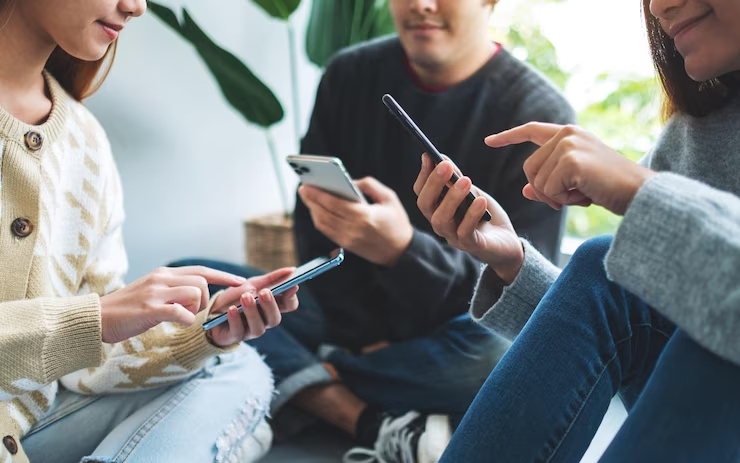
Phone use is an individual habit that we practice in public places and even on holidays. People check their phones about 80 times a day. Thanks to phones, we practice in public areas activities we used to do in private or dedicated places for them, such as serious conversations, arguing, buying clothes, doing work, checking emails, paying bills, listening to music, and playing games. Doing all these things in public places means that the use of public phones contributes to the formation of our environment.
Using our phones this way can create unpleasant situations that others experience involuntarily. Anyone who has had to be in an enclosed space, like a bus, and had to hear someone talking loudly on the phone is aware of this situation. Kio Stark, a teacher in the interactive communication program at New York University who focuses on how people interact with technology, says that using the phone leads people to treat public places as private places. She believes that blurring the lines between public and private places leads to a sense of alienation rather than communication. If a phone conversation creeps into other people's space, they will likely try to avoid it and the people involved.
Research shows that phones isolate us in our bubbles, making us talk and smile less to other people. Losing communication opportunities undermines individual happiness, as well as the social atmosphere. Psychologists at Columbia University found in 2013 that people who smile, communicate visually, and talk habitually to a waiter in a cafe are in a better mood than those who give up such gestures to make themselves more “efficient.”
Interaction without phones
Our habits make the benefits of pleasurable interactions easy to forget. Researchers at the University of Chicago found in 2014 that people underestimate the positive effects of interacting with others, especially strangers.
What do we trade for these positive interactions? Facebook makes people lonely and sadder, encouraging us to prefer quantity over quality interaction. Research suggests that many young people feel isolated and lonely, and those aged 18-22 are the most lonely. While that can't be entirely attributed to phone use, smartphones can't help.
When many people experience the same sense of alienation and don't seem to be able to get past dopamine-infused reactions in posts, updates, likes, and comments, they review their shared spaces for suffering. You've probably noticed this if you've ever looked at the subway and seen everyone drowning in their phones or if you look around a restaurant to see people - including couples - all staring at their phones.
Artists such as Hannah Gadsby, Alicia Keys, Dave Chappelle, Ariana Grande and Jack White used bags to create these spaces in their performances. Some hospitals, courts, and schools now use them, and people can rent them for weddings, conferences, and parties. Many trains now include a quiet place without phones. Some restaurants offer discounts to diners who refrain from using phones, while others strictly prohibit the use of phones. Such examples indicate a great tendency towards creating free spaces without phones.
The possibility of banning the use of the phone looms on the horizon. Many people - including people with disabilities - rely on their phones to safely navigate and interact with their environments. According to author Edward Tenner, forced use of technology without breaks may cause separation anxiety. Instead of banning phones altogether, the ideal solution is to provide environments of expectations that increase people's interaction with others and with things around the individual.
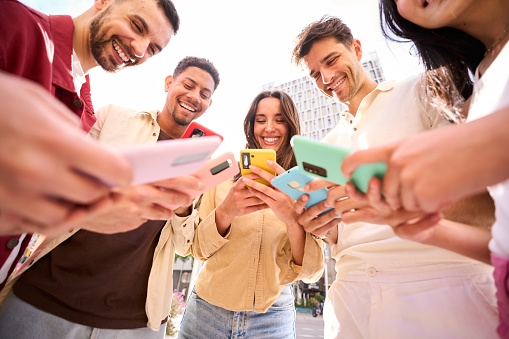
Increasingly, research indicates that the public is ready for this solution. According to the Pew Research Center, 54% of teens and 36% of parents in the United States believe they spend much time on their phones. In comparison, 65% of parents are concerned about their children's phone use, and nearly half of the teens report that phones distract their parents despite their permanently being attached to them.
My college students express frustration with the dwindling of personal interactions. People gather for dinner and sometimes stay up all night enjoying uninterrupted conversation, which would be impossible in other circumstances. Goldberg said, "I think we all kind of need that once a week."
The presence of phones in social places
The mere presence of phones in social settings creates distance between people. Two experiments conducted by researchers at the University of Essex in 2012 found that people who met and talked while sitting at a table with their phones on felt “less close to their partners and reported lower quality relationships with their partners, compared to those who chatted without a mobile phone.”
These distancing effects have been amplified when discussing very personal matters. Phone-free spaces refocus on social interaction, which can help people create the familiarity we usually try to establish via screens in vain.
Leaving our phones allows us to enjoy moments we will miss while engaging in social networking sites, which we will experience only once.